The slow death
Crucifixion!
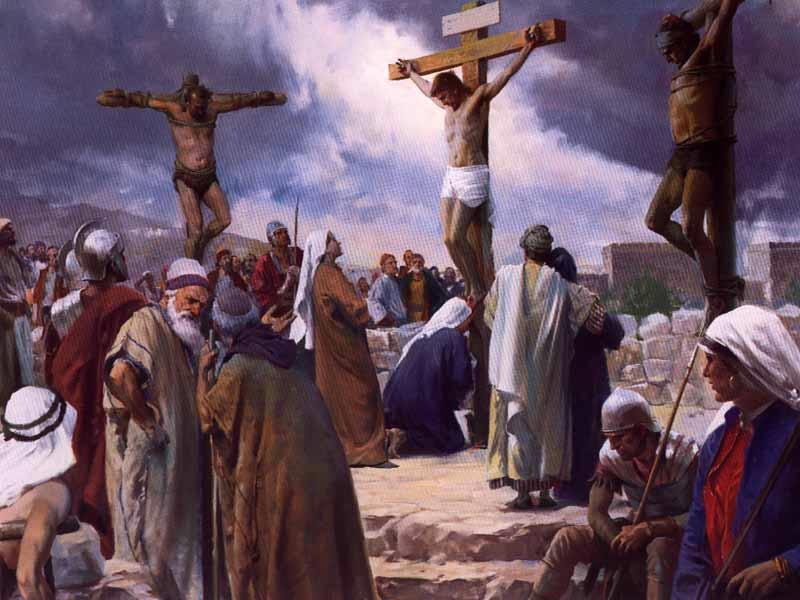
Crucifixion was not merely a method of execution; it was also a psychological weapon designed to intimidate anyone who challenged the authority of the Roman Empire. Crucifixion was meant to inflict maximum pain while slowly killing its victim. Death on the cross was reserved for traitors, slaves, foreigners, and the lowest of criminals. While Rome permitted slavery, it but considered crucifixion so horrendous that it was illegal to crucify a Roman citizen, regardless of their crime.
The first public crucifixions took on a carnival atmosphere and attracted large, boisterous crowds. But by the time Jesus hung on the cross, crucifixions had become routine. The once loud, curious mobs had long since disappeared, leaving only Jesus' mother and a handful of followers and accusers to watch the Messiah die. To many of the people of Jerusalem, the Messiah's death was just another ho-hum execution.
With the jeers of their accusers filling their ears, the ill-fated prisoners were led to their execution site and stripped naked, adding to their humiliation. Then, primitive iron nails six to eight inches long with two-inch sharpened points were pounded through their hands or wrists with a heavy mallet. Experienced executioners knew precisely where to place the nails to cut the tendons that run the length of the arm up to the shoulders. With severed tendons, the crucified were forced to use their back and shoulder muscles to support their weight as they hung on the cross. Once the executioner hammered down the wrists of the struggling victim, a single nail was driven through both feet to anchor them to the wooden cross. The crucifix was then raised, and the base of the cross dropped into a three-foot-deep hole with a jarring thud. If they had inexperienced or hurried executioners, one or both of the struggling prisoner's wrists could come loose as the cross dropped into place, causing them to fall forward with their feet still fastened to the crucifix. They were then brought back down, screaming and re-nailed.
After the naked, helpless victim was secured and the cross set upright in the air, the crucified would be on full display to the eyes of the taunting crowd, and the deathwatch would begin. Death on the cross was slow. The gradual physical decline gave the condemned time to contemplate their impending death as they writhed in agony. The intense physical and psychological misery steadily increased as the sufferer slowly succumbed to dehydration, blood loss, trauma, shock, fear, pain, and sheer exhaustion. Most died from suffocation when they lost the strength to hold themselves up on the cross.
As the weight of their weakening upper torso collapsed over their diaphragm, breathing became difficult. The victims found they inhale but couldn't exhale. The only way to catch a breath was to pull themselves up the cross by their nailed wrists. This tore flesh and tendons causing excruciating pain as the weight of the body bore down on the punctured wrists.
When the crucified raised themselves on the cross, their arm and shoulder muscles quickly cramped and weakened. When they could take the pain no longer, the condemned would sink back down and rest their weight on the nail driven through their feet. Lowering themselves on the cross relieved the pain in the upper torso, but the agony in their feet, ankles, and legs sent sharp, throbbing shivers through their body, and the pectoral muscles in the chest again became paralyzed. In the panic for another breath, they would again pull themselves back up the cross by their wrists. If a man passed out, he was quickly jarred awake as his body gasped for air. This agonizing up-and-down struggle was repeated over and over until, finally, death came. In Jesus' case, it took over three hours to die.
If the crucified were still alive when the executioners were ready to leave, their legs were broken to keep them from pushing themselves up the cross for another breath. With shattered legs, death came quickly. It was not until 313 AD, nearly 280 after Jesus died on the cross, that Rome finally outlawed crucifixion.

Crucifixion!
Crucifixion was not merely a method of execution; it was also a psychological weapon designed to intimidate anyone who challenged the authority of the Roman Empire. Crucifixion was meant to inflict maximum pain while slowly killing its victim. Death on the cross was reserved for traitors, slaves, foreigners, and the lowest of criminals. While Rome permitted slavery, it but considered crucifixion so horrendous that it was illegal to crucify a Roman citizen, regardless of their crime.
The first public crucifixions took on a carnival atmosphere and attracted large, boisterous crowds. But by the time Jesus hung on the cross, crucifixions had become routine. The once loud, curious mobs had long since disappeared, leaving only Jesus' mother and a handful of followers and accusers to watch the Messiah die. To many of the people of Jerusalem, the Messiah's death was just another ho-hum execution.
With the jeers of their accusers filling their ears, the ill-fated prisoners were led to their execution site and stripped naked, adding to their humiliation. Then, primitive iron nails six to eight inches long with two-inch sharpened points were pounded through their hands or wrists with a heavy mallet. Experienced executioners knew precisely where to place the nails to cut the tendons that run the length of the arm up to the shoulders. With severed tendons, the crucified were forced to use their back and shoulder muscles to support their weight as they hung on the cross. Once the executioner hammered down the wrists of the struggling victim, a single nail was driven through both feet to anchor them to the wooden cross. The crucifix was then raised, and the base of the cross dropped into a three-foot-deep hole with a jarring thud. If they had inexperienced or hurried executioners, one or both of the struggling prisoner's wrists could come loose as the cross dropped into place, causing them to fall forward with their feet still fastened to the crucifix. They were then brought back down, screaming and re-nailed.
After the naked, helpless victim was secured and the cross set upright in the air, the crucified would be on full display to the eyes of the taunting crowd, and the deathwatch would begin. Death on the cross was slow. The gradual physical decline gave the condemned time to contemplate their impending death as they writhed in agony. The intense physical and psychological misery steadily increased as the sufferer slowly succumbed to dehydration, blood loss, trauma, shock, fear, pain, and sheer exhaustion. Most died from suffocation when they lost the strength to hold themselves up on the cross.
As the weight of their weakening upper torso collapsed over their diaphragm, breathing became difficult. The victims found they inhale but couldn't exhale. The only way to catch a breath was to pull themselves up the cross by their nailed wrists. This tore flesh and tendons causing excruciating pain as the weight of the body bore down on the punctured wrists.
When the crucified raised themselves on the cross, their arm and shoulder muscles quickly cramped and weakened. When they could take the pain no longer, the condemned would sink back down and rest their weight on the nail driven through their feet. Lowering themselves on the cross relieved the pain in the upper torso, but the agony in their feet, ankles, and legs sent sharp, throbbing shivers through their body, and the pectoral muscles in the chest again became paralyzed. In the panic for another breath, they would again pull themselves back up the cross by their wrists. If a man passed out, he was quickly jarred awake as his body gasped for air. This agonizing up-and-down struggle was repeated over and over until, finally, death came. In Jesus' case, it took over three hours to die.
If the crucified were still alive when the executioners were ready to leave, their legs were broken to keep them from pushing themselves up the cross for another breath. With shattered legs, death came quickly. It was not until 313 AD, nearly 280 after Jesus died on the cross, that Rome finally outlawed crucifixion.

The Gospel According to St. Matthew
The King James Bible
|
Matthew 27:27-44
Nailed down 27 Then the soldiers of the governor took Jesus into the common hall, and gathered unto him the whole band of soldiers. 28 And they stripped him, and put on him a scarlet robe. 29 And when they had platted a crown of thorns, they put it upon his head, and a reed in his right hand: and they bowed the knee before him, and mocked him, saying, Hail, King of the Jews! 30 And they spit upon him, and took the reed, and smote him on the head. 31 And after that they had mocked him, they took the robe off from him, and put his own raiment on him, and led him away to crucify him. 32 And as they came out, they found a man of Cyrene, Simon by name: him they compelled to bear his cross. 33 And when they were come unto a place called Golgotha, that is to say, a place of a skull, 34 They gave him vinegar to drink mingled with gall: and when he had tasted thereof, he would not drink. 35 And they crucified him, and parted his garments, casting lots: that it might be fulfilled which was spoken by the prophet, They parted my garments among them, and upon my vesture did they cast lots. 36 And sitting down they watched him there; 37 And set up over his head his accusation written, THIS IS JESUS THE KING OF THE JEWS. 38 Then were there two thieves crucified with him, one on the right hand, and another on the left. 39 And they that passed by reviled him, wagging their heads, 40 And saying, Thou that destroyest the temple, and buildest it in three days, save thyself. If thou be the Son of God, come down from the cross. 41 Likewise also the chief priests mocking him, with the scribes and elders, said, 42 He saved others; himself he cannot save. If he be the King of Israel, let him now come down from the cross, and we will believe him. 43 He trusted in God; let him deliver him now, if he will have him: for he said, I am the Son of God. 44 The thieves also, which were crucified with him, cast the same in his teeth. |
Margin notes:
"The soldiers of the governor took Jesus into the common hall." (27:27) - These soldiers were assigned to Pontius Pilate. As governor, he had a personal military detachment. The "common hall" was called the Praetorium (Mark 15:16). "Gathered unto him the whole band of soldiers." (27:27) - "The whole company of (Pilate's) soldiers gathered around Jesus." "Platted a crown of thorns." (27:29) - Means "twisted together a crown of thorns." "A reed in his right hand." (27:29) - "A scepter in his right hand." "Mocked him." (27:29) - "Made fun of Him." "The Jews in their trial, had mocked him (Luke 22:63-65). Herod and his soldiers had mocked him (Luke 23:11). Now Pilate's soldiers mock him. And, a little later, on the cross, priests, elders and scribes mock him (27:29-43). To their brutal minds it was great sport to see one who claimed to be the Son of God having to submit to such humiliation and torture." ("Halley's Bible Handbook" by Henry H. Halley, Zondervan Publishing House, Grand Rapids, Michigan) "And they spit upon him." (27:30) - Just as prophesied in Isaiah 50:6 seven hundred years before Jesus was born. "Smote him on the head." (27:30) - "Hit him on the head." "Put his own raiment on him." (27:31) - "Put his own clothes on him." "As they came out." (27:32) - They left Jerusalem and headed for the crucifixion site. "A man of Cyrene, Simon by name." (27:32) - Cyrene was the capital of Cyrenaica (present-day Libya) in North Africa. Founded by the Greeks in 630 BC, the city boasted a large Jewish population. Many Jews from Cyrene migrated to Jerusalem and established their own synagogue, as mentioned in Acts 6:9. Simon was either visiting the Holy City during the Passover holiday or had moved there and was part of the synagogue of the Cyrenians. The synagogue was destroyed in the 4th century. Simon's son Rufus (Mark 15:21) later became a prominent member of the early Christian church (Romans 16:13). Simon's wife was also a Christian and helped Paul. "Him they compelled to bear his cross." (27:32) - "They forced him (Simon) to carry Jesus' cross." Remember, Jesus was weakened by the scourging. "Golgotha." (27:33) - Golgotha is Aramaic for "the place of the skull"(Matthew 27:33; Mark 15:22; John 19:17). In Latin, it was called Calvary (Luke 23:33). Golgotha/Calvary was a small hill northwest of Jerusalem just outside the gates of the city (Hebrews 13:12). It was used to execute criminals. Crucifixions were commonly held on hilltops so that passersby could easily see the execution and be warned. The main road into Jerusalem ran past Golgotha/Calvary, giving travelers a clear view of Jesus' crucifixion (Mark 15:29). There was a garden nearby and a fresh grave where Jesus was buried (John 19:41). "They gave him vinegar to drink." (27:34) - As prophesied centuries earlier in Psalm 69:21. Vinegar was a cheap, sour wine (Numbers 6:3) popular with Roman soldiers. See "Today's Question" below to learn why Jesus refused to drink the vinegar. "They parted my garments among them, and upon my vesture did they cast lots." (27:35) - Four soldiers (John 19:23-24) divided up Jesus' clothes as prophesied in Psalms 22:18 hundreds of years earlier. "They that passed by reviled him." (27:39) - Travelers coming from or going to Jerusalem insulted him, just as prophesied in Psalm 22:7-8. "The thieves also, which were crucified with him, cast the same in his teeth." (27:44) - "The thieves crucified with him, insulted him, too." Fortunately, one thief repented, asked Jesus to remember him in heaven, and was forgiven (Luke 23:39-43). |
Christ's suffering was foretold seven hundred years earlier in Isaiah 53. Read Mark 15:16-31; Luke 23:26-49; and John 19:17-24 to learn more about the crucifixion.
New Living Translation
Matthew 27:27-44
The Soldiers Mock Jesus
27 Some of the governor's soldiers took Jesus into their headquarters and called out the entire regiment.
28 They stripped him and put a scarlet robe on him.
29 They wove thorn branches into a crown and put it on his head, and they placed a reed stick in his right hand as a scepter. Then they knelt before him in mockery and taunted, "Hail! King of the Jews!"
30 And they spit on him and grabbed the stick and struck him on the head with it.
31 When they were finally tired of mocking him, they took off the robe and put his own clothes on him again. Then they led him away to be crucified.
The Crucifixion
32 Along the way, they came across a man named Simon, who was from Cyrene, and the soldiers forced him to carry Jesus' cross.
33 And they went out to a place called Golgotha (which means "Place of the Skull").
34 The soldiers gave him wine mixed with bitter gall, but when he had tasted it, he refused to drink it.
35 After they had nailed him to the cross, the soldiers gambled for his clothes by throwing dice.
36 Then they sat around and kept guard as he hung there.
37 A sign was fastened to the cross above Jesus' head, announcing the charge against him. It read: "This is Jesus, the King of the Jews."
38 Two revolutionaries were crucified with him, one on his right and one on his left.
39 The people passing by shouted abuse, shaking their heads in mockery.
40 "Look at you now!" they yelled at him. "You said you were going to destroy the Temple and rebuild it in three days. Well then, if you are the Son of God, save yourself and come down from the cross!"
41 The leading priests, the teachers of religious law, and the elders also mocked Jesus.
42 "He saved others," they scoffed, "but he can't save himself! So he is the King of Israel, is he? Let him come down from the cross right now, and we will believe in him!
43 He trusted God, so let God rescue him now if he wants him! For he said, 'I am the Son of God.'"
44 Even the revolutionaries who were crucified with him ridiculed him in the same way.
This second Bible text from the "New Living Translation" (Tyndale House, Publishers, Wheaton, Illinois) is a paraphrase and not an accurate word-for-word translation of the Bible. However, it is a helpful tool when read with the "King James Version."
The Soldiers Mock Jesus
27 Some of the governor's soldiers took Jesus into their headquarters and called out the entire regiment.
28 They stripped him and put a scarlet robe on him.
29 They wove thorn branches into a crown and put it on his head, and they placed a reed stick in his right hand as a scepter. Then they knelt before him in mockery and taunted, "Hail! King of the Jews!"
30 And they spit on him and grabbed the stick and struck him on the head with it.
31 When they were finally tired of mocking him, they took off the robe and put his own clothes on him again. Then they led him away to be crucified.
The Crucifixion
32 Along the way, they came across a man named Simon, who was from Cyrene, and the soldiers forced him to carry Jesus' cross.
33 And they went out to a place called Golgotha (which means "Place of the Skull").
34 The soldiers gave him wine mixed with bitter gall, but when he had tasted it, he refused to drink it.
35 After they had nailed him to the cross, the soldiers gambled for his clothes by throwing dice.
36 Then they sat around and kept guard as he hung there.
37 A sign was fastened to the cross above Jesus' head, announcing the charge against him. It read: "This is Jesus, the King of the Jews."
38 Two revolutionaries were crucified with him, one on his right and one on his left.
39 The people passing by shouted abuse, shaking their heads in mockery.
40 "Look at you now!" they yelled at him. "You said you were going to destroy the Temple and rebuild it in three days. Well then, if you are the Son of God, save yourself and come down from the cross!"
41 The leading priests, the teachers of religious law, and the elders also mocked Jesus.
42 "He saved others," they scoffed, "but he can't save himself! So he is the King of Israel, is he? Let him come down from the cross right now, and we will believe in him!
43 He trusted God, so let God rescue him now if he wants him! For he said, 'I am the Son of God.'"
44 Even the revolutionaries who were crucified with him ridiculed him in the same way.
This second Bible text from the "New Living Translation" (Tyndale House, Publishers, Wheaton, Illinois) is a paraphrase and not an accurate word-for-word translation of the Bible. However, it is a helpful tool when read with the "King James Version."
Key verses from this passage
"And when they had platted a crown of thorns, they put it upon his head, and a reed in his right hand: and they bowed the knee before him, and mocked him, saying, Hail, King of the Jews! And they spit upon him, and took the reed, and smote him on the head." (27:29-30)
"And they crucified him, and parted his garments, casting lots: that it might be fulfilled which was spoken by the prophet, They parted my garments among them, and upon my vesture did they cast lots." (27:35)
"And they that passed by reviled him, wagging their heads, And saying, Thou that destroyest the temple, and buildest it in three days, save thyself. If thou be the Son of God, come down from the cross. Likewise also the chief priests mocking him, with the scribes and elders, said, He saved others; himself he cannot save. If he be the King of Israel, let him now come down from the cross, and we will believe him." (27:39-42)
"And they crucified him, and parted his garments, casting lots: that it might be fulfilled which was spoken by the prophet, They parted my garments among them, and upon my vesture did they cast lots." (27:35)
"And they that passed by reviled him, wagging their heads, And saying, Thou that destroyest the temple, and buildest it in three days, save thyself. If thou be the Son of God, come down from the cross. Likewise also the chief priests mocking him, with the scribes and elders, said, He saved others; himself he cannot save. If he be the King of Israel, let him now come down from the cross, and we will believe him." (27:39-42)
Today's Question:
1. Why wouldn't Jesus drink the vinegar "mingled with gall?" (27:34)
Did someone forward this lesson to you? Sign up today to receive them for free. [email protected]
1. Why wouldn't Jesus drink the vinegar "mingled with gall?" (27:34)
Did someone forward this lesson to you? Sign up today to receive them for free. [email protected]
Answer: (Do you agree?)
1. The vinegar offered to Jesus was not the condiment we know today. It was a cheap wine popular with Roman soldiers. When mixed with gall, it acted as a narcotic painkiller. The narcotic dulled the senses, making the victim less aware of their circumstances while the painkiller alleviated their suffering. Someone, perhaps out of compassion, offered this mixture to Jesus, but He refused to drink it. He chose to endure the full suffering of our sins as He hung on the cross.
Application thought for the day:
Make a list of the painful and humiliating things done to Jesus. How did He respond?
Tip Jar
Help us send Free Bible Lessons to new believers.
Your donation makes this a better world.
Help us send Free Bible Lessons to new believers.
Your donation makes this a better world.
Visit us on Facebook and Instagram below
to explore hundreds of our original postings.
Thanks to the writings and commentary of John Wesley and Adam Clarke. Also, "The Layman's Bible Study Notebook" by Irving Jensen, published by Harvest House Publishing, Irvine, California; the "Life Change Series," published by NavPress books, Colorado Springs, Colorado; "Robertson's New Testament Word Studies;" "The MacArthur Bible Commentary" by John MacArthur, published by Thomas Nelson, Nashville, Tennessee; "Wisdom of the Bible" CD by Topics Entertainment, Inc., Renton, Washington for their inspiring pictures; "My utmost for His Highest" by Oswald Chambers, published by Barbour Publishing, Inc., Uhrichsville, Ohio; The "Treasury of Scriptural Knowledge" by Reuben Archer Torrey; "Hope For Each Day" by Billy Graham, published by J. Countryman, a division of Thomas Nelson, Inc., Nashville, Tennessee; "Easton's Bible Dictionary" by Matthew George Easton; "Unger's Bible Dictionary" by Merrill F. Unger, published by Moody Press, Chicago, Illinois; "Atlas of the Bible" edited by Joseph L. Gardner, published by Readers Digest, Pleasantville, New York; "Halley's Bible Handbook" by Henry H. Halley, Zondervan Publishing House, Grand Rapids, Michigan; "The Everyday Bible," published by World Wide Publications, Minneapolis, Minnesota; "The New Testament" Recovery Version, published by Living Stream Ministry, Anaheim, California; "The Living New Testament," published by Tyndale house, Wheaten, Illinois; "The New Living Translation," published by Tyndale House, Wheaten, Illinois; "The New Testament" translated from the Latin Vulgate, published by Guild Press, New York, New York; the "Life Application Study Bible," published by Tyndale House Publishing, Carol Stream, Illinois; the "Quest Study Bible," published by The Zondervan Corporation, Grand Rapids, Michigan; "The New Scofield Reference Bible," published by Oxford University Press, New York, New York; BibleGateway.com for all their wonderful links; and of course, the "King James Bible." All were critical in putting these lessons together.
© 2025 evolke
© 2025 evolke