Luke
2:1-20
Lesson 105
2:1-20
Lesson 105
|
Luke 2:1-20
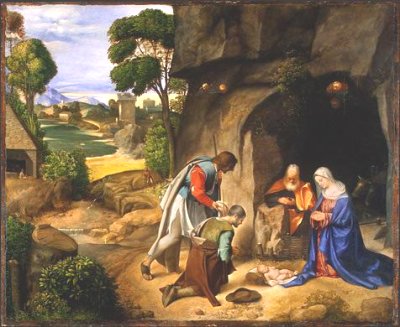
The Messiah is born 1 And it came to pass in those days, that there went out a decree from Caesar Augustus that all the world should be taxed. 2 (And this taxing was first made when Cyrenius was governor of Syria.) 3 And all went to be taxed, every one into his own city. 4 And Joseph also went up from Galilee, out of the city of Nazareth, into Judaea, unto the city of David, which is called Bethlehem; (because he was of the house and lineage of David:) 5 To be taxed with Mary his espoused wife, being great with child. 6 And so it was, that, while they were there, the days were accomplished that she should be delivered. 7 And she brought forth her firstborn son, and wrapped him in swaddling clothes, and laid him in a manger; because there was no room for them in the inn. 8 And there were in the same country shepherds abiding in the field, keeping watch over their flock by night. 9 And, lo, the angel of the Lord came upon them, and the glory of the Lord shone round about them: and they were sore afraid. 10 And the angel said unto them, Fear not: for, behold, I bring you good tidings of great joy, which shall be to all people. 11 For unto you is born this day in the city of David a Saviour, which is Christ the Lord. 12 And this shall be a sign unto you; Ye shall find the babe wrapped in swaddling clothes, lying in a manger. 13 And suddenly there was with the angel a multitude of the heavenly host praising God, and saying, 14 Glory to God in the highest, and on earth peace, good will toward men. 15 And it came to pass, as the angels were gone away from them into heaven, the shepherds said one to another, Let us now go even unto Bethlehem, and see this thing which is come to pass, which the Lord hath made known unto us. 16 And they came with haste, and found Mary, and Joseph, and the babe lying in a manger. 17 And when they had seen it, they made known abroad the saying which was told them concerning this child. 18 And all they that heard it wondered at those things which were told them by the shepherds. 19 But Mary kept all these things, and pondered them in her heart. 20 And the shepherds returned, glorifying and praising God for all the things that they had heard and seen, as it was told unto them. |
Margin notes:
"Caesar Augustus." (2:1) - Caius Caesar Octavianus Augustus, the Roman emperor who ruled from 27 BC until his death in AD 14 at the age of seventy-six. "All the world should be taxed." (2:1) -"All the empire should be counted." This was a census, designed to help Rome count its subjects and tax them. "Roman historical records place the enrolment of Quirinius in AD 7 which was 10 or 12 years after Jesus was born. This historical discrepancy was for a long time troublesome to Biblical students. But in recent years ancient papyri have been found from which it is learned that Quirinius was twice governor of Syria. Luke expressly says it was "the first" enrolment. It has been found also that people were required to go to their ancestral homes for the census." ("Halley's Bible Handbook" by Henry H. Halley, Zondervan Publishing House, Grand Rapids, Michigan; page 490) "Cyrenius." (2:2) - The Greek form of the Roman name Publius Sulpicius Quirinius. "All went to be taxed." (2:3) - "All went to be registered." "Joseph also went up from Galilee." (2:4) - It was a seventy mile, three-day walk from Nazareth to Bethlehem. "He was of the house and lineage of David." (2:4) - Actually, both Joseph and Mary were descended from King David. "Bethlehem." (2:4) - Meaning, "bread of life, Bethlehem was originally called Ephrath (Genesis 35:19; 48:7). It was a small town in Judea five miles south of Jerusalem on the highway from Hebron to Egypt. We see in this passage, it was also called "the city of David." It is the birthplace of Jesus Christ as prophesied in Micah 5:2. Unfortunately, since Jesus was raised in Nazareth, many didn't know He was born in Bethlehem and didn't connect Him with the prophecy. "Being great with child." (2:5) - When Joseph and Mary left for Bethlehem, she was nine months pregnant. "She brought forth her firstborn son." (2:7) - The Messiah is born, as promised seven hundred years earlier in Isaiah 9:6. In every major religion, mankind reaches out to God. In Christianity, God reached out to mankind and gave us His Son. Additional note: Jesus was born as a man in Bethlehem, but He always existed as God (John 17:5). We shouldn't let Jesus' humble beginnings fool us. He will return in glory, wearing a golden sash and His face shining like the sun (Revelation 1:13-16). "Swaddling clothes." (2:7) - These are strips of cloth wrapped around babies to keep them warm. "Shepherds." (2:8) - Shepherds had no real homes, they lived a nomadic life and were regarded as second class citizens. In biblical times they weren't even allowed to testify in court. Interestingly, God chose to announce the greatest news in human history to lowly shepherds instead of the great religious leaders of the time. Also, the shepherds job was to tend to sheep, including the ones to be sacrificed. When Jesus was born, shepherds tended to Him, the last sacrifice. "Abiding in the field." (2:8) - Means, "living in the field." "The angel of the Lord came upon them." (2:9) - One angel visited the shepherds to announce Jesus' birth. See verse 2:13. "Sore afraid." (2:9) - "Greatly afraid." "I bring you good tidings." (2:10) - "I bring you good news." "For unto you is born." (2:11) - For unto, "you" shows that Jesus is a personal savior. He came to save everyone who has faith, one person at a time. "The city of David." (2:11) - Bethlehem was called the "city of (King) David" because he was born there. "Suddenly there was with the angel a multitude of the heavenly host praising God." (2:13) - "Suddenly the angel was joined by a heavenly army of angels praising God." The sky must have been filled with angels. No wonder the shepherds dropped everything and rushed to find the newborn Messiah. "Glory to God in the highest, and on earth peace, good will toward men." (2:14) - This verse, spoken by angels, is referred to as the "Gloria." "When they had seen it, they made known abroad." (2:17) - "When they had seen Him (Jesus), they told everyone." "All they that heard it wondered at those things." (2:18) - "Everyone who heard it was amazed." "Pondered them in her heart." (2:19) - Just like any loving mother, Mary held the memories of her child close to her heart (Luke 2:42-51). |