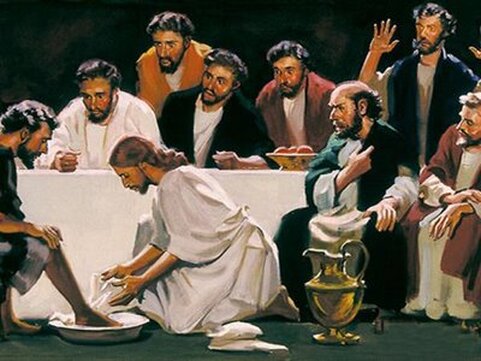
John 13:1-20
Lesson 198
Lesson 198
|
John 13:1-20
Jesus came to serve 1 Now before the feast of the passover, when Jesus knew that his hour was come that he should depart out of this world unto the Father, having loved his own which were in the world, he loved them unto the end. 2 And supper being ended, the devil having now put into the heart of Judas Iscariot, Simon's son, to betray him; 3 Jesus knowing that the Father had given all things into his hands, and that he was come from God, and went to God; 4 He riseth from supper, and laid aside his garments; and took a towel, and girded himself. 5 After that he poureth water into a bason, and began to wash the disciples' feet, and to wipe them with the towel wherewith he was girded. 6 Then cometh he to Simon Peter: and Peter saith unto him, Lord, dost thou wash my feet? 7 Jesus answered and said unto him, What I do thou knowest not now; but thou shalt know hereafter. 8 Peter saith unto him, Thou shalt never wash my feet. Jesus answered him, If I wash thee not, thou hast no part with me. 9 Simon Peter saith unto him, Lord, not my feet only, but also my hands and my head. 10 Jesus saith to him, He that is washed needeth not save to wash his feet, but is clean every whit: and ye are clean, but not all. 11 For he knew who should betray him; therefore said he, Ye are not all clean. 12 So after he had washed their feet, and had taken his garments, and was set down again, he said unto them, Know ye what I have done to you? 13 Ye call me Master and Lord: and ye say well; for so I am. 14 If I then, your Lord and Master, have washed your feet; ye also ought to wash one another's feet. 15 For I have given you an example, that ye should do as I have done to you. 16 Verily, verily, I say unto you, The servant is not greater than his lord; neither he that is sent greater than he that sent him. 17 If ye know these things, happy are ye if ye do them. 18 I speak not of you all: I know whom I have chosen: but that the scripture may be fulfilled, He that eateth bread with me hath lifted up his heel against me. 19 Now I tell you before it come, that, when it is come to pass, ye may believe that I am he. 20 Verily, verily, I say unto you, He that receiveth whomsoever I send receiveth me; and he that receiveth me receiveth him that sent me. |
Margin notes:
"He loved them unto the end." (13:1) - Just as Jesus loved His disciples, He loves us. "Supper." (13:2) - This is the Passover meal that Jesus enjoyed with His disciples on Thursday evening. Christians call it "The Last Supper." "Jesus knowing that the Father had given all things into his hands..." (13:3) - Jesus knew He was divine and had been sent by God. "Girded himself." (13:4) - Means Jesus wrapped a towel around His waist. Girding was a common practice when preparing to work. For additional insight, read Luke 12:37. "Wash the disciples' feet." (13:5) - Such a degrading task was usually performed by servants or slaves. This came right after the disciples had argued which of them was the greatest (Luke 22:24). Jesus "had to get down on his hands and knees and wash their feet, the menial service of a slave, to burn into their minds that he had called them to serve, and not to rule. Oh, how the church has suffered through all the centuries because so many of its leaders have been consumed by the passion to be great! Great churchmen, instead of humbly serving Christ, have used the name of Christ to serve themselves." ("Halley's Bible Handbook" by Henry H. Halley, Zondervan Publishing House, Grand Rapids, Michigan; page 546) "Dost thou wash my feet?" (13:6) - "Are you going to wash my feet?" "But thou shalt know hereafter." (13:7) - "But you will know later." "If I wash thee not, thou hast no part with me." (13:8) - Without spiritual cleansing, we cannot belong to God. "He that is washed needeth not save to wash his feet, but is clean every whit." (13:10) - "He who has bathed doesn't need to wash again, except his feet, to be clean all over." Bible scholars disagree on the meaning of this passage. Some believe that Jesus meant, due to the dusty roads, even a freshly bathed person would have unclean feet after a brief walk. While others feel that Jesus was saying the Jewish requirement to be ritually cleaned will be fulfilled with just this partial bathing. "Ye are clean, but not all." (13:10) - One of the disciples was unclean, Judas, the betrayer. "He knew who should betray him." (13:11) - Jesus knew from "the beginning" that Judas would betray Him (John 6:64; 6:70). "Know ye what I have done." (13:12) - "Do you know what I have done." Jesus was teaching His disciples that they were to serve and not be served. "Ye say well." (13:13) - "You are right." "Ye also ought to wash one another's feet." (13:14) - This means we should be humble and serve each other (1 Peter 5:5). "Verily." (13:16) - "Truly." "He that eateth bread with me hath lifted up his heel against me." (13:18) - This refers to Judas Iscariot's betrayal of Christ, as prophesized in Psalm 41:9 centuries earlier. "Now I tell you before it come." (13:19) - "I'll tell you now, before it happens." Before the night is over, Jesus will repeat this to His disciples (John 14:29). "He that receiveth whomsoever I send receiveth me." (13:20) - Because Jesus lives inside believers, the way you treat a Christian is, in essence, the way you treat the Messiah. Jesus is reinforcing this truth from Matthew 10:40 and Luke 10:16. |