|
In this lesson:
The Feast of Tabernacles is over. The adulteress. Study Tip: Repetition is a tool writers use to emphasize key points. Whenever you see themes repeated in the Bible, this is a clue that God considers them essential. Hover over these passages a little longer to fully grasp their meaning. |

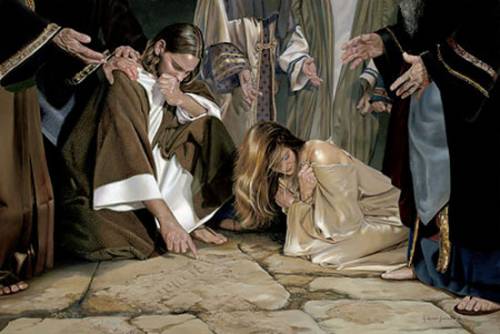
Jesus and the adulterous woman.
By an unknown artist |
Where was -
Mount of Olives -
Sometimes called Mount of Olivet, the Mount of Olives is a small mountain located less than two miles east of
Jerusalem. 2 Kings 23:13 calls it "the mount of corruption" due to the pagan altars King Solomon built there (I Kings 11:7). Jesus spent many nights on the Mount of Olives when visiting Jerusalem (Luke 21:37; 22:39), and it was here the Pharisees had Him arrested. Ezekiel 11:23 and Zechariah 14:4-9 tells us that when Christ returns to establish His kingdom, it will be to the Mount of Olives.
Mount of Olives -
Sometimes called Mount of Olivet, the Mount of Olives is a small mountain located less than two miles east of
Jerusalem. 2 Kings 23:13 calls it "the mount of corruption" due to the pagan altars King Solomon built there (I Kings 11:7). Jesus spent many nights on the Mount of Olives when visiting Jerusalem (Luke 21:37; 22:39), and it was here the Pharisees had Him arrested. Ezekiel 11:23 and Zechariah 14:4-9 tells us that when Christ returns to establish His kingdom, it will be to the Mount of Olives.
The Gospel According to St. John
The King James Bible
|
John 8:1-11
"Go, and sin no more." (Many ancient Greek manuscripts do not include verses 8:1-11) 1 Jesus went unto the mount of Olives. 2 And early in the morning he came again into the temple, and all the people came unto him; and he sat down, and taught them. 3 And the scribes and Pharisees brought unto him a woman taken in adultery; and when they had set her in the midst, 4 They say unto him, Master, this woman was taken in adultery, in the very act. 5 Now Moses in the law commanded us, that such should be stoned: but what sayest thou? 6 This they said, tempting him, that they might have to accuse him. But Jesus stooped down, and with his finger wrote on the ground, as though he heard them not. 7 So when they continued asking him, he lifted up himself, and said unto them, He that is without sin among you, let him first cast a stone at her. 8 And again he stooped down, and wrote on the ground. 9 And they which heard it, being convicted by their own conscience, went out one by one, beginning at the eldest, even unto the last: and Jesus was left alone, and the woman standing in the midst. 10 When Jesus had lifted up himself, and saw none but the woman, he said unto her, Woman, where are those thine accusers? hath no man condemned thee? 11 She said, No man, Lord. And Jesus said unto her, Neither do I condemn thee: go, and sin no more. |
Margin notes:
"He came again into the temple." (8:2) - Jesus went to the part of the Temple known as the treasury (8:20). "All the people came unto him." (8:2) - Means a large crowd came to hear Jesus teach. "They had set her in the midst." (8:3) - The scribes and Pharisees brought the woman before Jesus and the assembled crowd listening to Him. "This woman was taken in adultery." (8:4) - She was engaged to one man and intimate with another. "The law commanded us, that such should be stoned." (8:5) - Actually, Mosaic Law called for both parties caught in adultery to be put to death (Leviticus 20:10, Deuteronomy 22:22). But only after a fair trial, not by a mob. "Tempting him." (8:6) - Means "testing Him." This was not the first time the Pharisees tried to trip Jesus up (Matthew 22:15). "Wrote on the ground." (8:6) - This is the only recorded time that Jesus wrote." "He that is without sin among you, let him first cast a stone at her." (8:7) - Once again, Jesus cleverly escapes the trap set for Him by the scribes and Pharisees. Had Jesus called for the stoning of the woman, He could have been reported to the Romans. They had the sole authority to put people to death. Had Jesus called for her release, He would have been violating the Law of Moses. See also Romans 2:1. "Neither do I condemn thee." (8:11) - Because Jesus came to save, not condemn us (Luke 9:56; John 3:17). |
New Living Translation
John 8:1-11
A Woman Caught in Adultery
[Some ancient Greek manuscripts do not include John 8:1-11]
1 Jesus returned to the Mount of Olives,
2 but early the next morning he was back again at the Temple. A crowd soon gathered, and he sat down and taught them.
3 As he was speaking, the teachers of religious law and the Pharisees brought a woman who had been caught in the act of adultery. They put her in front of the crowd.
4 "Teacher," they said to Jesus, "this woman was caught in the act of adultery.
5 The law of Moses says to stone her. What do you say?"
6 They were trying to trap him into saying something they could use against him, but Jesus stooped down and wrote in the dust with his finger.
7 They kept demanding an answer, so he stood up again and said, "All right, but let the one who has never sinned throw the first stone!"
8 Then he stooped down again and wrote in the dust.
9 When the accusers heard this, they slipped away one by one, beginning with the oldest, until only Jesus was left in the middle of the crowd with the woman.
10 Then Jesus stood up again and said to the woman, "Where are your accusers? Didn't even one of them condemn you?"
11 "No, Lord," she said.
And Jesus said, "Neither do I. Go and sin no more."
This second Bible text from the "New Living Translation" (Tyndale House, Publishers, Wheaton, Illinois) is a paraphrase and not an accurate word for word translation of the Bible. However, it is a helpful tool when read with the "King James Version."
A Woman Caught in Adultery
[Some ancient Greek manuscripts do not include John 8:1-11]
1 Jesus returned to the Mount of Olives,
2 but early the next morning he was back again at the Temple. A crowd soon gathered, and he sat down and taught them.
3 As he was speaking, the teachers of religious law and the Pharisees brought a woman who had been caught in the act of adultery. They put her in front of the crowd.
4 "Teacher," they said to Jesus, "this woman was caught in the act of adultery.
5 The law of Moses says to stone her. What do you say?"
6 They were trying to trap him into saying something they could use against him, but Jesus stooped down and wrote in the dust with his finger.
7 They kept demanding an answer, so he stood up again and said, "All right, but let the one who has never sinned throw the first stone!"
8 Then he stooped down again and wrote in the dust.
9 When the accusers heard this, they slipped away one by one, beginning with the oldest, until only Jesus was left in the middle of the crowd with the woman.
10 Then Jesus stood up again and said to the woman, "Where are your accusers? Didn't even one of them condemn you?"
11 "No, Lord," she said.
And Jesus said, "Neither do I. Go and sin no more."
This second Bible text from the "New Living Translation" (Tyndale House, Publishers, Wheaton, Illinois) is a paraphrase and not an accurate word for word translation of the Bible. However, it is a helpful tool when read with the "King James Version."
Key verses from this passage
"And the scribes and Pharisees brought unto him a woman taken in adultery; and when they had set her in the midst, They say unto him, Master, this woman was taken in adultery, in the very act. Now Moses in the law commanded us, that such should be stoned: but what sayest thou?" (8:3-5)
"So when they continued asking him, he lifted up himself, and said unto them, He that is without sin among you, let him first cast a stone at her." (8:7)
Today's Question:
1.Why did Jesus say that those without sin should cast the first stone? (8:7)
"The great thing to remember is that though our feelings come and go, God's love for us does not."
C.S. Lewis; Novelist, scholar, and lay theologian (1898-1963).
1.Why did Jesus say that those without sin should cast the first stone? (8:7)
"The great thing to remember is that though our feelings come and go, God's love for us does not."
C.S. Lewis; Novelist, scholar, and lay theologian (1898-1963).
Answer: (Do you agree?)
1. Jesus told those without sin to cast the first stone to admonish their hypocrisy and force the woman's accusers to examine their own lives. This is a remarkable story of compassion and forgiveness. When others commit sins, we often rush to judge them while forgetting our own faults. By making the crowd stop and ponder their wrongdoings, Jesus cleverly diluted their desire to punish the adulterous woman. In this passage, we see the accusers judge themselves (8:9). Later it is God who will judge.
Additional note: Notice that Jesus didn't condemn or condone her adultery. He simply forgave and told her to sin no more (8:11). Also, some Bible scholars believe that Jesus knew that the men condemning the woman were also guilty of adultery. Stoning her would have been hard on their consciences.
Application thought for the day:
Are you quick to judge others while keeping your own sins secret?
Visit us on Facebook and Instagram below
to explore hundreds of our original postings.
Thanks to the writings and commentary of John Wesley and Adam Clarke. Also, "The Layman's Bible Study Notebook" by Irving Jensen published by Harvest House Publishing, Irvine, California; the "Life Change Series" published by NavPress Books, Colorado Springs, Colorado; the "Life Application Study Bible" published by Tyndale House Publishing, Carol Stream, Illinois; the "Quest Study Bible" published by The Zondervan Corporation, Grand Rapids, Michigan; "Robertson's New Testament Word Studies; " "The MacArthur Bible Commentary" by John MacArthur published by Thomas Nelson, Nashville, Tennessee; "Wisdom of the Bible" CD by Topics Entertainment, Inc., Renton, Washington for their inspiring pictures; "My utmost for His Highest" by Oswald Chambers published by Barbour Publishing, Inc., Uhrichsville, Ohio; The "Treasury of Scriptural Knowledge" by Reuben Archer Torrey; "Hope For Each Day" by Billy Graham published by J. Countryman, a division of Thomas Nelson, Inc., Nashville, Tennessee; "Easton's Bible Dictionary" by Matthew George Easton; "Unger's Bible Dictionary" by Merrill F. Unger, published by Moody Press, Chicago, Illinois; "Halley's Bible Handbook" by Henry H. Halley, Zondervan Publishing House, Grand Rapids, Michigan; "The Everyday Bible" published by World Wide Publications, Minneapolis, Minnesota; "The Living New Testament" published by Tyndale house; "The New Living Translation" published by Tyndale House; "The New Testament" translated from the Latin Vulgate, published by Guild Press, New York, New York; BibleGateway.com for all their wonderful links; and of course the "King James Bible." All were critical in putting these lessons together.
© 2026 evolke
© 2026 evolke