|
In this lesson:
Jesus and the skeptical disciple. Why was the Gospel of John written? (20:30-31) Study Tip: The Bible can be complex, so it helps to study more than one translation. As you read each lesson, scroll back and forth between the "King James Version" and the "New Living Translation" below. Also, check the margin notes in blue and click on the links. |

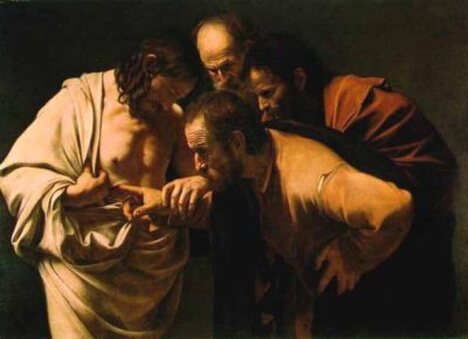
"Doubting Thomas" puts his finger in Jesus' wound.
(By the Italian baroque painter Michelangelo Merisi da Caravaggio (1571-1610) |
Who was -
Thomas -
One of the original twelve disciples (Matthew 10:2-3). We learn in verse 20:24 below that Thomas was also called Didymus (Greek for twin). Despite saying he was willing to die with Jesus (John 11:16), Thomas fled when Christ was arrested (Matthew 26:56; Mark 14:50). When the other disciples told Thomas they had seen the resurrected Jesus, he didn't believe them (John 20:24-25). This is where we get the term "Doubting Thomas." Eight days later, Thomas saw Jesus and was invited to place his finger inside His wounds (John 20:26-29). Thomas saw Jesus a second time on the Sea of Galilee (John 21:1-2). After that, he became a faithful servant spreading Christianity. Today, the Christians of Malabar, India, regard Thomas as the founder of their church and call themselves the "Thomas Christians."
Thomas -
One of the original twelve disciples (Matthew 10:2-3). We learn in verse 20:24 below that Thomas was also called Didymus (Greek for twin). Despite saying he was willing to die with Jesus (John 11:16), Thomas fled when Christ was arrested (Matthew 26:56; Mark 14:50). When the other disciples told Thomas they had seen the resurrected Jesus, he didn't believe them (John 20:24-25). This is where we get the term "Doubting Thomas." Eight days later, Thomas saw Jesus and was invited to place his finger inside His wounds (John 20:26-29). Thomas saw Jesus a second time on the Sea of Galilee (John 21:1-2). After that, he became a faithful servant spreading Christianity. Today, the Christians of Malabar, India, regard Thomas as the founder of their church and call themselves the "Thomas Christians."
The Gospel According to St. John
The King James Bible
|
John 20:24-31
Doubting Thomas 24 But Thomas, one of the twelve, called Didymus, was not with them when Jesus came. 25 The other disciples therefore said unto him, We have seen the LORD. But he said unto them, Except I shall see in his hands the print of the nails, and put my finger into the print of the nails, and thrust my hand into his side, I will not believe. 26 And after eight days again his disciples were within, and Thomas with them: then came Jesus, the doors being shut, and stood in the midst, and said, Peace be unto you. 27 Then saith he to Thomas, Reach hither thy finger, and behold my hands; and reach hither thy hand, and thrust it into my side: and be not faithless, but believing. 28 And Thomas answered and said unto him, My LORD and my God. 29 Jesus saith unto him, Thomas, because thou hast seen me, thou hast believed: blessed are they that have not seen, and yet have believed. 30 And many other signs truly did Jesus in the presence of his disciples, which are not written in this book: 31 But these are written, that ye might believe that Jesus is the Christ, the Son of God; and that believing ye might have life through his name. |
Margin notes:
"Put my finger into the print of the nails." (20:25) - "Put my finger into the hole of the nails." "After eight days." (20:26) - This would make it Sunday. "His disciples were within." (20:26) - Means, "His disciples were inside." "Reach hither thy finger." (20:27) - "Put your finger here." "My Lord and my God." (20:28) - After seeing the nail and spear holes in Jesus' body, Thomas was the first to call Him God. Additional note: By calling Jesus "My Lord and my God," Thomas was acknowledging that Jesus and God were one person, just as Jesus said in John 10:30 and 14:9. "Blessed are they that have not seen, and yet have believed." (20:29) - We are saved through our faith. Faith is believing in something you have never seen (Hebrew 11:1), like trusting Jesus without having met Him. "Many other signs...which are not written in this book." (20:30) - "Many other miracles...which are not written in this book" (John 21:25). "That ye might believe that Jesus is the Christ, the Son of God; and that believing ye might have life through his name." (20:31) - This is perhaps the key verse of John's entire Gospel. This is such an important teaching; it is reinforced in verses 3:18, 5:24, 6:37, 6:40, 6:47, and again in this passage. |
New Living Translation
John 20:24-31
Jesus Appears to Thomas
24 One of the twelve disciples, Thomas (nicknamed the Twin), was not with the others when Jesus came.
25 They told him, "We have seen the Lord!"
But he replied, "I won't believe it unless I see the nail wounds in his hands, put my fingers into them, and place my hand into the wound in his side."
26 Eight days later the disciples were together again, and this time Thomas was with them. The doors were locked; but suddenly, as before, Jesus was standing among them. "Peace be with you," he said.
27 Then he said to Thomas, "Put your finger here, and look at my hands. Put your hand into the wound in my side. Don't be faithless any longer. Believe!"
28 "My Lord and my God!" Thomas exclaimed.
29 Then Jesus told him, "You believe because you have seen me. Blessed are those who believe without seeing me."
Purpose of the Book
30 The disciples saw Jesus do many other miraculous signs in addition to the ones recorded in this book.
31 But these are written so that you may continue to believe that Jesus is the Messiah, the Son of God, and that by believing in him you will have life by the power of his name.
This second Bible text from the "New Living Translation" (Tyndale House, Publishers, Wheaton, Illinois) is a paraphrase and not an accurate word for word translation of the Bible. However, it is a helpful tool when read with the "King James Version."
Jesus Appears to Thomas
24 One of the twelve disciples, Thomas (nicknamed the Twin), was not with the others when Jesus came.
25 They told him, "We have seen the Lord!"
But he replied, "I won't believe it unless I see the nail wounds in his hands, put my fingers into them, and place my hand into the wound in his side."
26 Eight days later the disciples were together again, and this time Thomas was with them. The doors were locked; but suddenly, as before, Jesus was standing among them. "Peace be with you," he said.
27 Then he said to Thomas, "Put your finger here, and look at my hands. Put your hand into the wound in my side. Don't be faithless any longer. Believe!"
28 "My Lord and my God!" Thomas exclaimed.
29 Then Jesus told him, "You believe because you have seen me. Blessed are those who believe without seeing me."
Purpose of the Book
30 The disciples saw Jesus do many other miraculous signs in addition to the ones recorded in this book.
31 But these are written so that you may continue to believe that Jesus is the Messiah, the Son of God, and that by believing in him you will have life by the power of his name.
This second Bible text from the "New Living Translation" (Tyndale House, Publishers, Wheaton, Illinois) is a paraphrase and not an accurate word for word translation of the Bible. However, it is a helpful tool when read with the "King James Version."
Key verses from this passage
"But Thomas, one of the twelve, called Didymus, was not with them when Jesus came. The other disciples therefore said unto him, We have seen the LORD. But he said unto them, Except I shall see in his hands the print of the nails, and put my finger into the print of the nails, and thrust my hand into his side, I will not believe." (20:24-25)
"Jesus saith unto him, Thomas, because thou hast seen me, thou hast believed: blessed are they that have not seen, and yet have believed. And many other signs truly did Jesus in the presence of his disciples, which are not written in this book." (20:29-30)
Today's Question:
1. How was Jesus able to enter the disciples hiding place with the doors shut and locked? (20:26)
Feel free to share these lessons with others.
If you know someone interested in receiving them direct, have them contact us at [email protected].
1. How was Jesus able to enter the disciples hiding place with the doors shut and locked? (20:26)
Feel free to share these lessons with others.
If you know someone interested in receiving them direct, have them contact us at [email protected].
Answer: (Do you agree?)
1. We don't know. The resurrected Christ was flesh and bone (Luke 24:39), not an apparition. Yet, Jesus' body was different than the flesh and blood body He had before the crucifixion. Jesus ate, drank (Luke 24:41-43; John 21:12-15), and could be physically touched by others, yet He could move instantly from one place to another and materialize in a closed room like an apparition. It is beyond our human understanding and requires faith that Christ can do all things.
Application thought for the day:
As Thomas demonstrates, doubt can be a good thing if it "leads to questions, (and) the questions lead to answers, and the answers are accepted."
(From "The Life Application Study Bible" published by Tyndale House Publishing, Carol Stream, Illinois; page 2107).
Unfortunately for some, doubt leads to stubbornness, and in their stubbornness, they reject the truth. In time, their doubt becomes their religion.
Visit us on social media below.
Explore hundreds of our original postings.
Thanks to the writings and commentary of John Wesley and Adam Clarke. Also, "The Layman's Bible Study Notebook" by Irving Jensen published by Harvest House Publishing, Irvine, California; the "Life Change Series" published by NavPress Books, Colorado Springs, Colorado; the "Life Application Study Bible" published by Tyndale House Publishing, Carol Stream, Illinois; the "Quest Study Bible" published by The Zondervan Corporation, Grand Rapids, Michigan; "Robertson's New Testament Word Studies;" "The MacArthur Bible Commentary" by John MacArthur published by Thomas Nelson, Nashville, Tennessee; "Wisdom of the Bible" CD by Topics Entertainment, Inc., Renton, Washington for their inspiring pictures; "My utmost for His Highest" by Oswald Chambers published by Barbour Publishing, Inc., Uhrichsville, Ohio; The "Treasury of Scriptural Knowledge" by Reuben Archer Torrey; "Hope For Each Day" by Billy Graham published by J. Countryman, a division of Thomas Nelson, Inc., Nashville, Tennessee; "Easton's Bible Dictionary" by Matthew George Easton; "Unger's Bible Dictionary" by Merrill F. Unger, published by Moody Press, Chicago, Illinois; "Halley's Bible Handbook" by Henry H. Halley, Zondervan Publishing House, Grand Rapids, Michigan; "The Everyday Bible" published by World Wide Publications, Minneapolis, Minnesota; "The Living New Testament" published by Tyndale house; "The New Living Translation" published by Tyndale House; "The New Testament" translated from the Latin Vulgate, published by Guild Press, New York, New York; BibleGateway.com for all their wonderful links; and of course the "King James Bible." All were critical in putting these lessons together.
© 2026 evolke
© 2026 evolke