Luke
23:1-25
Lesson 158
23:1-25
Lesson 158
|
Luke 23:1-25
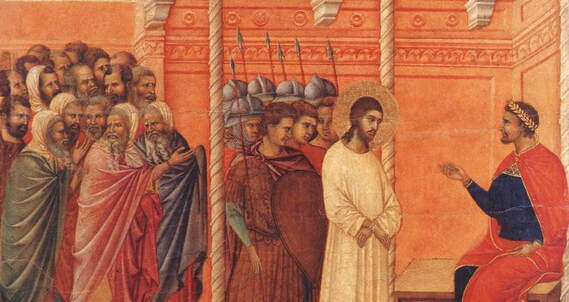
Death sentence 1 And the whole multitude of them arose, and led him unto Pilate. 2 And they began to accuse him, saying, We found this fellow perverting the nation, and forbidding to give tribute to Caesar, saying that he himself is Christ a King. 3 And Pilate asked him, saying, Art thou the King of the Jews? And he answered him and said, Thou sayest it. 4 Then said Pilate to the chief priests and to the people, I find no fault in this man. 5 And they were the more fierce, saying, He stirreth up the people, teaching throughout all Jewry, beginning from Galilee to this place. 6 When Pilate heard of Galilee, he asked whether the man were a Galilaean. 7 And as soon as he knew that he belonged unto Herod's jurisdiction, he sent him to Herod, who himself also was at Jerusalem at that time. 8 And when Herod saw Jesus, he was exceeding glad: for he was desirous to see him of a long season, because he had heard many things of him; and he hoped to have seen some miracle done by him. 9 Then he questioned with him in many words; but he answered him nothing. 10 And the chief priests and scribes stood and vehemently accused him. 11 And Herod with his men of war set him at nought, and mocked him, and arrayed him in a gorgeous robe, and sent him again to Pilate. 12 And the same day Pilate and Herod were made friends together: for before they were at enmity between themselves. 13 And Pilate, when he had called together the chief priests and the rulers and the people, 14 Said unto them, Ye have brought this man unto me, as one that perverteth the people: and, behold, I, having examined him before you, have found no fault in this man touching those things whereof ye accuse him: 15 No, nor yet Herod: for I sent you to him; and, lo, nothing worthy of death is done unto him. 16 I will therefore chastise him, and release him. 17 (For of necessity he must release one unto them at the feast.) 18 And they cried out all at once, saying, Away with this man, and release unto us Barabbas: 19 (Who for a certain sedition made in the city, and for murder, was cast into prison.) 20 Pilate therefore, willing to release Jesus, spake again to them. 21 But they cried, saying, Crucify him, crucify him. 22 And he said unto them the third time, Why, what evil hath he done? I have found no cause of death in him: I will therefore chastise him, and let him go. 23 And they were instant with loud voices, requiring that he might be crucified. And the voices of them and of the chief priests prevailed. 24 And Pilate gave sentence that it should be as they required. 25 And he released unto them him that for sedition and murder was cast into prison, whom they had desired; but he delivered Jesus to their will. |
Margin notes:
"Pilate." (23:1) - Pontius Pilate was the fifth governor of Judea, who ruled from 26 AD to 36 AD. Pilate had already served for six years before Jesus stood before him. His cruelty (Luke 13:1) had already forced his superiors to rebuke him once. Another complaint from the Jewish population could jeopardize his political future. "We found this fellow perverting the nation, and forbidding to give tribute." (23:2) - "We found this man subverting the nation, telling people not to pay taxes." This is a lie meant to turn Pilate against Jesus. In fact, the religious leaders tried without success to trick Jesus into speaking out against paying taxes (Luke 20:22-26). "Art thou the King of the Jews?" (23:3) - "Are you the Jews Messiah?" "Thou sayest it." (23:3) - A colloquial saying meaning, "yes." "Throughout all Jewry." (23:5) - "Throughout all Judea." "Herod's jurisdiction." (23:7) - Herod Antipas, the son of King Herod the Great (who tried to kill Jesus as an infant) ruled over Perea and Galilee, half of his father's former empire. "He was desirous to see him of a long season." (23:8) - Means, "He wanted to meet Jesus for a long time" (Luke 9:9). "He had heard many things of him." (23:8) - As documented in Matthew 14:1. "Men of war set him at nought." (23:11) - "The soldiers (guarding Jesus) ridiculed him." "Arrayed him in a gorgeous robe." (23:11) - "Dressed him in a gorgeous robe." "One that perverteth the people." (23:14) - "One that turns the people against Rome." "Nothing worthy of death Is done unto him." (23:15) - "He hasn't done anything worthy of the death penalty." "I will therefore chastise him, and release him." (23:16) - "I will scourge him and release Him." "He must release one unto them at the feast." (23:17) - As a sign of goodwill, the Romans usually released a prisoner during the Passover holiday (John 18:39). This year, Pilate gave the people a choice between releasing Barabbas or Jesus. "Barabbas." (23:18) - A well-known thief (Matthew 27:16; John 18:40) and murderer (23:19) arrested for taking part in an insurrection against Rome (Mark 15:7). In a few hours, Jesus will be punished instead of Barabbas', and us. Also, see "Today's Question" below. "Sedition." (23:19) - "Insurrection." "Crucify him." (23:21) - "Crucifixion was the most painful and disgraceful form of execution the Romans employed" ("The MacArthur Bible Commentary" by John MacArthur published by Thomas Nelson, Nashville Tennessee; Pg. 1330). "I will therefore chastise him, and let him go." (23:22) - Pilate knew Jesus was innocent (23:4; 23:14-15) and was "determined to let him go" (Acts 3:13). |