|
In this lesson:
The Sanhedrin condemns Jesus to death (27:1). Judas is remorseful and commits suicide (27:3-10). Jesus stands before Pontius Pilate, the Roman governor (27:11-14). Study Tip: Write down important Bible verses, ponder their meaning, and memorize them. Build a list of your favorite verses. |
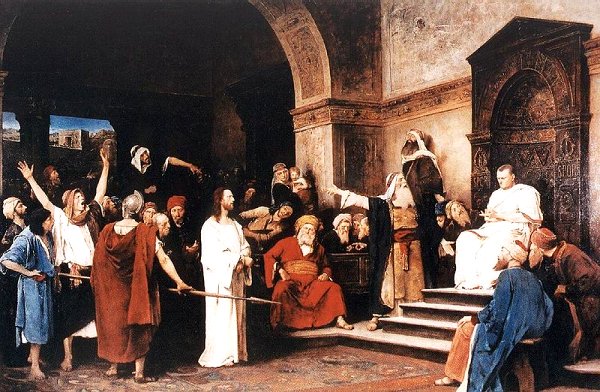
Christ before Pilate
By the Hungarian realist artist Mihály Munkácsy (1844-1900). |
Who was -
Pontius Pilate -
Pontius Pilate was the fifth Roman procurator (governor) of Judea and Samaria. He served from AD 26 to 36 and disliked his Judean assignment so far from Rome. Pilate, no fan of the Jews, was routinely accused of cruelty, accusations he largely deserved. He had a reputation throughout Judea of being merciless and brutal. Jesus was well aware of Pilate's reputation (Luke 13:1-2).
The Jewish religious leaders returned Pilate's animosity and frequently complained to Rome about him. They accused him of corruption, cruelty, insensitivity to their customs and religion, and even of stealing money from the Temple to build an aqueduct. While Pilate's residence and headquarters were in Caesarea, he was in Jerusalem with his wife, Claudia Procula, to keep order doing the influx of pilgrims for the Passover holiday.
While Pilate was in Jerusalem, the Jewish high council (Sanhedrin) brought Jesus to stand trial before him. The Sanhedrin lacked the authority to sentence a prisoner to death (John 18:31), so they pressured Pilate to crucify Jesus. A pure politician, Pilate was more interested in political expediency than justice. Already disciplined by Rome once, Pilate was hesitant to release Jesus and risk more Jewish complaints. He repeatedly declared Jesus innocent (Luke 23:4; 23:14; 23:22; John 18:38) yet was prepared to execute Him (Matthew 27:24-26; Mark 15:15). In AD 36, four years after Jesus was crucified, Pilate lost favor with Rome when the Governor of Syria brought more charges of cruelty against him. He was exiled to Vienne in Gaul, where he committed suicide in AD 38. Tradition has it that Pilate's wife, Claudia, became a Christian.
Pontius Pilate -
Pontius Pilate was the fifth Roman procurator (governor) of Judea and Samaria. He served from AD 26 to 36 and disliked his Judean assignment so far from Rome. Pilate, no fan of the Jews, was routinely accused of cruelty, accusations he largely deserved. He had a reputation throughout Judea of being merciless and brutal. Jesus was well aware of Pilate's reputation (Luke 13:1-2).
The Jewish religious leaders returned Pilate's animosity and frequently complained to Rome about him. They accused him of corruption, cruelty, insensitivity to their customs and religion, and even of stealing money from the Temple to build an aqueduct. While Pilate's residence and headquarters were in Caesarea, he was in Jerusalem with his wife, Claudia Procula, to keep order doing the influx of pilgrims for the Passover holiday.
While Pilate was in Jerusalem, the Jewish high council (Sanhedrin) brought Jesus to stand trial before him. The Sanhedrin lacked the authority to sentence a prisoner to death (John 18:31), so they pressured Pilate to crucify Jesus. A pure politician, Pilate was more interested in political expediency than justice. Already disciplined by Rome once, Pilate was hesitant to release Jesus and risk more Jewish complaints. He repeatedly declared Jesus innocent (Luke 23:4; 23:14; 23:22; John 18:38) yet was prepared to execute Him (Matthew 27:24-26; Mark 15:15). In AD 36, four years after Jesus was crucified, Pilate lost favor with Rome when the Governor of Syria brought more charges of cruelty against him. He was exiled to Vienne in Gaul, where he committed suicide in AD 38. Tradition has it that Pilate's wife, Claudia, became a Christian.

The Gospel According to St. Matthew
The King James Bible
|
Matthew 27:1-14
Jesus stands before Pilate 1 When the morning was come, all the chief priests and elders of the people took counsel against Jesus to put him to death: 2 And when they had bound him, they led him away, and delivered him to Pontius Pilate the governor. 3 Then Judas, which had betrayed him, when he saw that he was condemned, repented himself, and brought again the thirty pieces of silver to the chief priests and elders, 4 Saying, I have sinned in that I have betrayed the innocent blood. And they said, What is that to us? see thou to that. 5 And he cast down the pieces of silver in the temple, and departed, and went and hanged himself. 6 And the chief priests took the silver pieces, and said, It is not lawful for to put them into the treasury, because it is the price of blood. 7 And they took counsel, and bought with them the potter's field, to bury strangers in. 8 Wherefore that field was called, The field of blood, unto this day. 9 Then was fulfilled that which was spoken by Jeremy the prophet, saying, And they took the thirty pieces of silver, the price of him that was valued, whom they of the children of Israel did value; 10 And gave them for the potter's field, as the Lord appointed me. 11 And Jesus stood before the governor: and the governor asked him, saying, Art thou the King of the Jews? And Jesus said unto him, Thou sayest. 12 And when he was accused of the chief priests and elders, he answered nothing. 13 Then said Pilate unto him, Hearest thou not how many things they witness against thee? 14 And he answered him to never a word; insomuch that the governor marvelled greatly. |
Margin notes:
"The chief priests and elders of the people took counsel against Jesus to put him to death." (27:1) - "The (Jewish) chief priests and elders discussed how to put Jesus to death." They plotted against Jesus as prophesied centuries earlier in Psalm 2:2. "Delivered him to Pontius Pilate." (27:2) - Jesus was scourged and crucified, just as He predicted in Matthew 20:19. "Repented himself, and brought again the thirty pieces of silver." (27:3) - Means Judas was remorseful and tried to return the money The Pharisees paid him to betray Jesus (Matthew 26:14-15). "I have sinned." (27:4) - Judas knows that he sinned by betraying Jesus. See the last half of verse 27:4 for the priests' callous response. "What is that to us? see thou to that." (27:4) - "What's that to us? That's your problem." "It is the price of blood." (27:6) - "Its blood money." The high priests regarded the thirty pieces of silver as tainted and refused to return the money to their treasury. Although they were willing to condemn an innocent man to death, they strictly adhered to a minor Jewish law that prohibited the use of defiled money. Ironically, it was money that they themselves had tainted. "The field was called, The field of blood, unto this day." (27:8) - See Acts 1:19. "Then was fulfilled that which was spoken by Jeremy the prophet." (27:9) - Five hundred years before the birth of Christ, the Old Testament prophesied that Jesus would be betrayed for thirty pieces of silver, which would be returned to the Temple to purchase a potter's field (Zechariah 11:12-13). "He answered nothing." (27:12) - Jesus did not answer the charges against Him, just as prophesied in Isaiah 53:7 seven hundred years earlier and recorded in Acts 8:32. "He answered him to never a word." (27:14) - Jesus refused to answer the false charges just as He did when He stood trial before the Sanhedrin (26:62-63). |
New Living Translation
Matthew 27:1-14
Judas Hangs Himself
1 Very early in the morning the leading priests and the elders met again to lay plans for putting Jesus to death.
2 Then they bound him, led him away, and took him to Pilate, the Roman governor.
3 When Judas, who had betrayed him, realized that Jesus had been condemned to die, he was filled with remorse. So he took the thirty pieces of silver back to the leading priests and the elders.
4 "I have sinned," he declared, "for I have betrayed an innocent man."
"What do we care?" they retorted. "That's your problem."
5 Then Judas threw the silver coins down in the Temple and went out and hanged himself.
6 The leading priests picked up the coins. "It wouldn't be right to put this money in the Temple treasury," they said, "since it was payment for murder."
7 After some discussion they finally decided to buy the potter's field, and they made it into a cemetery for foreigners.
8 That is why the field is still called the Field of Blood.
9 This fulfilled the prophecy of Jeremiah that says,
"They took the thirty pieces of silver-
the price at which he was valued by the people of Israel,
10 and purchased the potter's field,
as the Lord directed."
Jesus' Trial before Pilate
11 Now Jesus was standing before Pilate, the Roman governor. "Are you the king of the Jews?" the governor asked him.
Jesus replied, "You have said it."
12 But when the leading priests and the elders made their accusations against him, Jesus remained silent.
13 "Don't you hear all these charges they are bringing against you?" Pilate demanded.
14 But Jesus made no response to any of the charges, much to the governor's surprise.
This second Bible text from the "New Living Translation" (Tyndale House, Publishers, Wheaton, Illinois) is a paraphrase and not an accurate word-for-word translation of the Bible. However, it is a helpful tool when read with the "King James Version."
Judas Hangs Himself
1 Very early in the morning the leading priests and the elders met again to lay plans for putting Jesus to death.
2 Then they bound him, led him away, and took him to Pilate, the Roman governor.
3 When Judas, who had betrayed him, realized that Jesus had been condemned to die, he was filled with remorse. So he took the thirty pieces of silver back to the leading priests and the elders.
4 "I have sinned," he declared, "for I have betrayed an innocent man."
"What do we care?" they retorted. "That's your problem."
5 Then Judas threw the silver coins down in the Temple and went out and hanged himself.
6 The leading priests picked up the coins. "It wouldn't be right to put this money in the Temple treasury," they said, "since it was payment for murder."
7 After some discussion they finally decided to buy the potter's field, and they made it into a cemetery for foreigners.
8 That is why the field is still called the Field of Blood.
9 This fulfilled the prophecy of Jeremiah that says,
"They took the thirty pieces of silver-
the price at which he was valued by the people of Israel,
10 and purchased the potter's field,
as the Lord directed."
Jesus' Trial before Pilate
11 Now Jesus was standing before Pilate, the Roman governor. "Are you the king of the Jews?" the governor asked him.
Jesus replied, "You have said it."
12 But when the leading priests and the elders made their accusations against him, Jesus remained silent.
13 "Don't you hear all these charges they are bringing against you?" Pilate demanded.
14 But Jesus made no response to any of the charges, much to the governor's surprise.
This second Bible text from the "New Living Translation" (Tyndale House, Publishers, Wheaton, Illinois) is a paraphrase and not an accurate word-for-word translation of the Bible. However, it is a helpful tool when read with the "King James Version."
Key verses from this passage
"Then Judas, which had betrayed him, when he saw that he was condemned, repented himself, and brought again the thirty pieces of silver to the chief priests and elders, Saying, I have sinned in that I have betrayed the innocent blood. And they said, What is that to us? see thou to that. And he cast down the pieces of silver in the temple, and departed, and went and hanged himself." (27:3-5)
"And Jesus stood before the governor: and the governor asked him, saying, Art thou the King of the Jews? And Jesus said unto him, Thou sayest." (27:11)
Today's Question:
1. Why did Pilate ask Jesus if He was "the King of the Jews?" (27:11)
"Your outer life is your reputation with people, your inner life is your reputation with God." Author unknown
1. Why did Pilate ask Jesus if He was "the King of the Jews?" (27:11)
"Your outer life is your reputation with people, your inner life is your reputation with God." Author unknown
Answers: (Do you agree?)
1. Pilate asked Jesus if He was the King of the Jews because "The Roman government was particularly sensitive to subversive elements in society that would undermine their base of power. Any who claimed to be a leader or a king could be a potential threat."
("Quest Study Bible" published by The Zondervan Corporation, Grand Rapids, Michigan; page 1430).
Additionally, the high priests knew that Pilate wouldn't consider a man charged with blasphemy against their God a threat to Rome. So, they lied and told Pilate that Jesus wanted to be king and encouraged people not to pay their taxes (Luke 23:1-2).
Application thought for the day:
If Jesus could forgive the men who crucified Him (Luke 23:34), then He could also forgive Judas. But rather than ask for forgiveness, Judas committed suicide (27:5). Whatever our past sins, faith in God, and repentance bring forgiveness.
Visit us on Facebook and Instagram below
to explore hundreds of our original postings.
Thanks to the writings and commentary of John Wesley and Adam Clarke. Also, "The Layman's Bible Study Notebook" by Irving Jensen, published by Harvest House Publishing, Irvine, California; the "Life Change Series," published by NavPress books, Colorado Springs, Colorado; "Robertson's New Testament Word Studies;" "The MacArthur Bible Commentary" by John MacArthur, published by Thomas Nelson, Nashville, Tennessee; "Wisdom of the Bible" CD by Topics Entertainment, Inc., Renton, Washington for their inspiring pictures; "My utmost for His Highest" by Oswald Chambers, published by Barbour Publishing, Inc., Uhrichsville, Ohio; The "Treasury of Scriptural Knowledge" by Reuben Archer Torrey; "Hope For Each Day" by Billy Graham, published by J. Countryman, a division of Thomas Nelson, Inc., Nashville, Tennessee; "Easton's Bible Dictionary" by Matthew George Easton; "Unger's Bible Dictionary" by Merrill F. Unger, published by Moody Press, Chicago, Illinois; "Atlas of the Bible" edited by Joseph L. Gardner, published by Readers Digest, Pleasantville, New York; "Halley's Bible Handbook" by Henry H. Halley, Zondervan Publishing House, Grand Rapids, Michigan; "The Everyday Bible," published by World Wide Publications, Minneapolis, Minnesota; "The New Testament" Recovery Version, published by Living Stream Ministry, Anaheim, California; "The Living New Testament," published by Tyndale house, Wheaten, Illinois; "The New Living Translation," published by Tyndale House, Wheaten, Illinois; "The New Testament" translated from the Latin Vulgate, published by Guild Press, New York, New York; the "Life Application Study Bible," published by Tyndale House Publishing, Carol Stream, Illinois; the "Quest Study Bible," published by The Zondervan Corporation, Grand Rapids, Michigan; "The New Scofield Reference Bible," published by Oxford University Press, New York, New York; BibleGateway.com for all their wonderful links; and of course, the "King James Bible." All were critical in putting these lessons together.
© 2025 evolke
© 2025 evolke