|
In this lesson:
Jesus makes His triumphal entry into Jerusalem (11:1-11). This is Sunday, the start of Passion Week. Jesus has five days to live. Also, the cursed fig tree. Study Tip: It helps to study more than one Bible translation. As you read, scroll back and forth between the "King James Bible" and the "New Living Translation" below. |
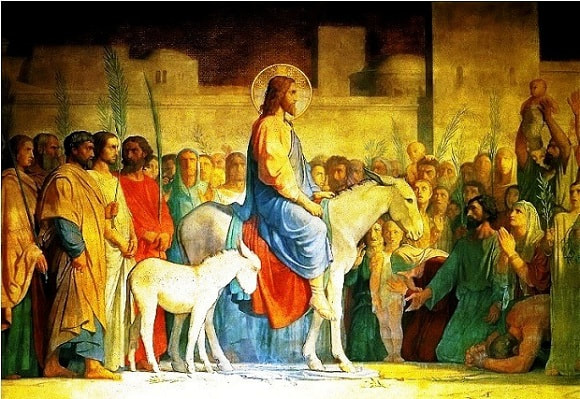
Jesus arrives in Jerusalem on Palm Sunday
By an unknown artist |
Where was -
Bethphage -
A small village near Bethany located between Jericho and Jerusalem on the Mount of Olives (Luke 19:29). The name Bethphage means "house of figs." The village no longer exists.
Bethany -
Another small village on the Mount of Olives "about fifteen furlongs" (two miles) east of Jerusalem (John 11:18). Jesus often stayed in Bethany when visiting nearby Jerusalem (Matthew 21:17) and performed one of His greatest miracles there, raising Lazarus from the dead (John 11:38-44; John 12:1). Bethany is now called el-Azariyeh (place of Lazarus) or simply Lazariyeh.
Mount of Olives -
Sometimes called Mount of Olivet, it is a small mountain less than two miles east of Jerusalem. 2 Kings 23:13 calls it "the mount of corruption" due to the pagan alters King Solomon built (I Kings 11:7) there centuries before the birth of Christ. Jesus spent many nights on the Mount of Olives when visiting Jerusalem (Luke 21:37; 22:39) and it was here that He was arrested. Ezekiel 11:23 and Zechariah 14:4-9 tell us that when Christ returns to establish His kingdom, it will be to the Mount of Olives.

Bethphage -
A small village near Bethany located between Jericho and Jerusalem on the Mount of Olives (Luke 19:29). The name Bethphage means "house of figs." The village no longer exists.
Bethany -
Another small village on the Mount of Olives "about fifteen furlongs" (two miles) east of Jerusalem (John 11:18). Jesus often stayed in Bethany when visiting nearby Jerusalem (Matthew 21:17) and performed one of His greatest miracles there, raising Lazarus from the dead (John 11:38-44; John 12:1). Bethany is now called el-Azariyeh (place of Lazarus) or simply Lazariyeh.
Mount of Olives -
Sometimes called Mount of Olivet, it is a small mountain less than two miles east of Jerusalem. 2 Kings 23:13 calls it "the mount of corruption" due to the pagan alters King Solomon built (I Kings 11:7) there centuries before the birth of Christ. Jesus spent many nights on the Mount of Olives when visiting Jerusalem (Luke 21:37; 22:39) and it was here that He was arrested. Ezekiel 11:23 and Zechariah 14:4-9 tell us that when Christ returns to establish His kingdom, it will be to the Mount of Olives.

The Gospel According to St. Mark
The King James Bible
|
Mark: 11:1-14
Jesus' last entry into Jerusalem 1 And when they came nigh to Jerusalem, unto Bethphage and Bethany, at the mount of Olives, he sendeth forth two of his disciples, 2 And saith unto them, Go your way into the village over against you: and as soon as ye be entered into it, ye shall find a colt tied, whereon never man sat; loose him, and bring him. 3 And if any man say unto you, Why do ye this? say ye that the Lord hath need of him; and straightway he will send him hither. 4 And they went their way, and found the colt tied by the door without in a place where two ways met; and they loose him. 5 And certain of them that stood there said unto them, What do ye, loosing the colt? 6 And they said unto them even as Jesus had commanded: and they let them go. 7 And they brought the colt to Jesus, and cast their garments on him; and he sat upon him. 8 And many spread their garments in the way: and others cut down branches off the trees, and strawed them in the way. 9 And they that went before, and they that followed, cried, saying, Hosanna; Blessed is he that cometh in the name of the Lord: 10 Blessed be the kingdom of our father David, that cometh in the name of the Lord: Hosanna in the highest. 11 And Jesus entered into Jerusalem, and into the temple: and when he had looked round about upon all things, and now the eventide was come, he went out unto Bethany with the twelve. 12 And on the morrow, when they were come from Bethany, he was hungry: 13 And seeing a fig tree afar off having leaves, he came, if haply he might find any thing thereon: and when he came to it, he found nothing but leaves; for the time of figs was not yet. 14 And Jesus answered and said unto it, No man eat fruit of thee hereafter for ever. And his disciples heard it. |
Margin notes:
"When they came nigh to Jerusalem." (11:1) - "When they came near Jerusalem." "Go your way into the village over against you." (11:2) - "Go into the village opposite you." "Find a colt tied, whereon never man sat." (11:2) - When using an animal for sacred purposes, it was considered more respectful to use an animal that had never been ridden. "Straightway he will send him hither." (11:3) - Means "Immediately, he will return him here." "Found the colt tied by the door without in a place where two ways met." (11:4) - "They found the colt tied outside by a door where two roads met." "Loosing the colt." (11:5) - Means; "Untying the colt." "And many spread their garments in the way: and others cut down branches off the trees, and strawed them in the way." (11:8) - "Many spread their clothes in the road, and others cut branches off the (palm) trees and spread them in the road." Placing clothes and branches in their path is an ancient custom to honor a king. The branches cut from palm trees represented joy and salvation. Additional note: Jesus rode a donkey colt into Jerusalem, thus fulfilling the five-hundred-year-old prophesy found in Zechariah 9:9. "Blessed is he that cometh in the name of the Lord." (11:9) - As prophesized in Psalm 118:22-26. "Jesus entered into Jerusalem." (11:11) - On what is now called Palm Sunday. Additional note: Jesus entered Jerusalem on a donkey that had never been ridden (11:2; Luke 19:30). What do donkeys and horses do the first time someone rides them? Do they say, "Climb on and I'll take you where you want to go" or do they throw the rider off? This animal knew who Jesus was. "When he had looked round about upon all things." (11:11) - "When He saw everything." "Now the eventide was come." (11:11) - "Now, evening had come." "If haply." (11:13) - "If perhaps." |
See Matthew 21:1-10 (lesson 41), Luke 19:29-38 and John 12:12-19 for more details on Jesus' entering Jerusalem.
New Living Translation
Mark: 11:1-14
Jesus' Triumphant Entry
1 As Jesus and his disciples approached Jerusalem, they came to the towns of Bethphage and Bethany on the Mount of Olives. Jesus sent two of them on ahead.
2 "Go into that village over there," he told them. "As soon as you enter it, you will see a young donkey tied there that no one has ever ridden. Untie it and bring it here.
3 If anyone asks, 'What are you doing?' just say, 'The Lord needs it and will return it soon.'"
4 The two disciples left and found the colt standing in the street, tied outside the front door.
5 As they were untying it, some bystanders demanded, "What are you doing, untying that colt?"
6 They said what Jesus had told them to say, and they were permitted to take it.
7 Then they brought the colt to Jesus and threw their garments over it, and he sat on it.
8 Many in the crowd spread their garments on the road ahead of him, and others spread leafy branches they had cut in the fields.
9 Jesus was in the center of the procession, and the people all around him were shouting,
"Praise God!
Blessings on the one who comes in the name of the Lord!
10 Blessings on the coming Kingdom of our ancestor David!
Praise God in highest heaven!"
11 So Jesus came to Jerusalem and went into the Temple. After looking around carefully at everything, he left because it was late in the afternoon. Then he returned to Bethany with the twelve disciples.
Jesus Curses the Fig Tree
12 The next morning as they were leaving Bethany, Jesus was hungry.
13 He noticed a fig tree in full leaf a little way off, so he went over to see if he could find any figs. But there were only leaves because it was too early in the season for fruit.
14 Then Jesus said to the tree, "May no one ever eat your fruit again!" And the disciples heard him say it.
This second Bible text from the "New Living Translation" (Tyndale House, Publishers, Wheaton, Illinois) is a paraphrase and not an accurate word for word translation of the Bible. However, it is a helpful tool when read with the "King James Version."
Jesus' Triumphant Entry
1 As Jesus and his disciples approached Jerusalem, they came to the towns of Bethphage and Bethany on the Mount of Olives. Jesus sent two of them on ahead.
2 "Go into that village over there," he told them. "As soon as you enter it, you will see a young donkey tied there that no one has ever ridden. Untie it and bring it here.
3 If anyone asks, 'What are you doing?' just say, 'The Lord needs it and will return it soon.'"
4 The two disciples left and found the colt standing in the street, tied outside the front door.
5 As they were untying it, some bystanders demanded, "What are you doing, untying that colt?"
6 They said what Jesus had told them to say, and they were permitted to take it.
7 Then they brought the colt to Jesus and threw their garments over it, and he sat on it.
8 Many in the crowd spread their garments on the road ahead of him, and others spread leafy branches they had cut in the fields.
9 Jesus was in the center of the procession, and the people all around him were shouting,
"Praise God!
Blessings on the one who comes in the name of the Lord!
10 Blessings on the coming Kingdom of our ancestor David!
Praise God in highest heaven!"
11 So Jesus came to Jerusalem and went into the Temple. After looking around carefully at everything, he left because it was late in the afternoon. Then he returned to Bethany with the twelve disciples.
Jesus Curses the Fig Tree
12 The next morning as they were leaving Bethany, Jesus was hungry.
13 He noticed a fig tree in full leaf a little way off, so he went over to see if he could find any figs. But there were only leaves because it was too early in the season for fruit.
14 Then Jesus said to the tree, "May no one ever eat your fruit again!" And the disciples heard him say it.
This second Bible text from the "New Living Translation" (Tyndale House, Publishers, Wheaton, Illinois) is a paraphrase and not an accurate word for word translation of the Bible. However, it is a helpful tool when read with the "King James Version."
Key verses from this passage
"And they brought the colt to Jesus, and cast their garments on him; and he sat upon him. And many spread their garments in the way: and others cut down branches off the trees, and strawed them in the way. And they that went before, and they that followed, cried, saying, Hosanna; Blessed is he that cometh in the name of the Lord." (11:7-9)
"And seeing a fig tree afar off having leaves, he came, if haply he might find any thing thereon: and when he came to it, he found nothing but leaves; for the time of figs was not yet. And Jesus answered and said unto it, No man eat fruit of thee hereafter for ever. And his disciples heard it." (11:13-14)
Today's Question:
1. Why did the crowd in Jerusalem give Jesus a warm welcome in Mark 11:7-10 but call for His death a few days later?
You don't need to know where you're going if you know the One who does.
1. Why did the crowd in Jerusalem give Jesus a warm welcome in Mark 11:7-10 but call for His death a few days later?
You don't need to know where you're going if you know the One who does.
Answer: (Do you agree?)
1. When Jesus arrived in Jerusalem, the crowds believed He was a great military and political leader who would drive the Romans out of Palestine and free them from bondage. They didn't understand that Jesus came to free them (and all mankind) from a different type of bondage, the bondage of sin. Because they didn't understand, they were quickly turned against Jesus by the bribes and lies of the Pharisees.
Application thought for the day:
Like the Temple in Jerusalem, the leafy fig tree (11:13) promised to bring forth fruit. But both the fig tree and the Temple were unproductive. The fig tree should have been bearing fruit but wasn't. The Temple promised to be a haven of worship but was no longer fulfilling that promise. In Mark 11:15-18 we will see Jesus clear out the Temple. That, and Jesus' cursing the fig tree are instructive messages to all, live your faith and be productive.
A free inductive Bible study since 2007.
Thanks to your prayers and faithful giving,
more unbelievers have come to know Jesus.
Please help us again!
Thanks to your prayers and faithful giving,
more unbelievers have come to know Jesus.
Please help us again!
Visit us on social media below
Explore hundreds of our original postings.
Thanks to the writings and commentary of John Wesley and Adam Clarke. Also, "The Layman's Bible Study Notebook" by Irving Jensen published by Harvest House Publishing, Irvine, California; the "Life Change Series" published by NavPress Books, Colorado Springs, Colorado; the "Life Application Study Bible" published by Tyndale House Publishing, Carol Stream, Illinois; "The Quest Study Bible" published by The Zondervan Corporation, Grand Rapids, Michigan; "Robertson's New Testament Word Studies"; "The MacArthur Bible Commentary" by John MacArthur published by Thomas Nelson, Nashville, Tennessee; "Wisdom of the Bible" CD by Topics Entertainment, Inc., Renton, Washington for their inspiring pictures; "My utmost for His Highest" by Oswald Chambers published by Barbour publishing, Inc., Uhrichsville, Ohio; The "Treasury of Scriptural Knowledge" by Reuben Archer Torrey; "Hope For Each Day" by Billy Graham published by J. Countryman, a division of Thomas Nelson, Inc., Nashville, Tennessee; "Easton's Bible Dictionary" by Matthew George Easton; "Unger's Bible Dictionary" by Merrill F. Unger, published by Moody Press, Chicago, Illinois; "Halley's Bible Handbook" by Henry H. Halley, Zondervan Publishing House, Grand Rapids, Michigan; "The Living New Testament" published by Tyndale house; "The New Living Translation" published by Tyndale House; BibleGateway.com for all their wonderful links; and of course the "King James Bible". All were critical in putting these lessons together.
© 2026 evolke
© 2026 evolke