|
In this lesson:
This lesson covers Saturday and Palm Sunday (day one of Passion Week). On Friday, Jesus will be crucified. Mary anoints the feet of Jesus (12:1-8). Jesus triumphantly returns to Jerusalem (12:12-19). Study Tip: "Don't forget the things the Bible has to teach you! Use a journal or notebook to keep track of the insights you pick up as you study." C. S. Lewis (1898-1963) |

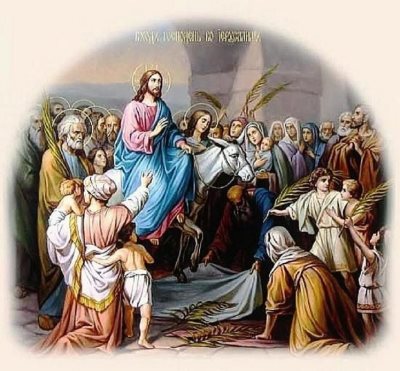
Jesus' triumphant return to Jerusalem.
By an unknown artist. |
The Gospel According to St. John
The King James Bible
|
John 12:1-19
Mary anoints Jesus' feet 1 Then Jesus six days before the passover came to Bethany, where Lazarus was, which had been dead, whom he raised from the dead. 2 There they made him a supper; and Martha served: but Lazarus was one of them that sat at the table with him. 3 Then took Mary a pound of ointment of spikenard, very costly, and anointed the feet of Jesus, and wiped his feet with her hair: and the house was filled with the odour of the ointment. 4 Then saith one of his disciples, Judas Iscariot, Simon's son, which should betray him, 5 Why was not this ointment sold for three hundred pence, and given to the poor? 6 This he said, not that he cared for the poor; but because he was a thief, and had the bag, and bare what was put therein. 7 Then said Jesus, Let her alone: against the day of my burying hath she kept this. 8 For the poor always ye have with you; but me ye have not always. 9 Much people of the Jews therefore knew that he was there: and they came not for Jesus' sake only, but that they might see Lazarus also, whom he had raised from the dead. 10 But the chief priests consulted that they might put Lazarus also to death; 11 Because that by reason of him many of the Jews went away, and believed on Jesus. 12 On the next day much people that were come to the feast, when they heard that Jesus was coming to Jerusalem, 13 Took branches of palm trees, and went forth to meet him, and cried, Hosanna: Blessed is the King of Israel that cometh in the name of the Lord. 14 And Jesus, when he had found a young ass, sat thereon; as it is written, 15 Fear not, daughter of Sion: behold, thy King cometh, sitting on an ass's colt. 16 These things understood not his disciples at the first: but when Jesus was glorified, then remembered they that these things were written of him, and that they had done these things unto him. 17 The people therefore that was with him when he called Lazarus out of his grave, and raised him from the dead, bare record. 18 For this cause the people also met him, for that they heard that he had done this miracle. 19 The Pharisees therefore said among themselves, Perceive ye how ye prevail nothing? behold, the world is gone after him. |
Margin notes:
"Then Jesus six days before the Passover came to Bethany." (12:1) - Means Jesus arrived in Bethany on Saturday, six days before Passover. "Whom he raised from the dead." (12:1) - This is the same Lazarus Jesus resurrected in verses 11:43-44 (lesson 193). "There they made him a supper; and Martha served." (12:2) - This was not the first time Jesus dined with Lazarus and his sisters Martha and Mary (Luke 10:38-42). "Mary." (12:3) - There are seven Mary's mentioned in the New Testament. This is Mary of Bethany, sister to Lazarus and Martha. "A pound of ointment." (12:3) - A pound was 12 ounces. "Spikenard." (12:3) - An expensive perfumed ointment imported from India. "Anointed the feet of Jesus." (12:3) - Normally, an honored guest would have his head anointed. For a host/hostess to anoint a visitor's feet was an act of humility and showed royal respect for the guest. This was not the first time Jesus was anointed (Matthew 26:6-7; Mark 14:3; Luke 7:36-38). "Wiped his feet with her hair." (12:3) - A woman's long hair was considered her "glory" (1 Corinthians 11:15), so drying Jesus' feet this way made the anointing an even greater act of humility and respect for the Messiah. "Three hundred pence." (12:5) - About a year's wage for the average worker, a tidy sum. Mary, Martha, and Lazarus must have been wealthy to afford such expensive perfume. "Had the bag." (12:6) - Judas was in charge of the money purse. "Bare what was put therein." (12:6) - "Helped himself to the money inside." "Let her alone: against the day of my burying hath she kept this." (12:7) - "Let her alone, she did this in preparation of my burial." "The poor always ye have with you."(12:8) - Jesus is referencing Deuteronomy 15:11. "But me ye have not always." (12:8) - Jesus knows they will crucify Him in six days. "That they might see Lazarus also." (12:9) - Jesus was the hot topic of conversation since He raised Lazarus from the dead, but the people wanted to see Lazarus too. "Many of the Jews went away, and believed on Jesus." (12:11) - "Many Jews left the synagogue and followed Jesus." "On the next day." (12:12) - It's now Palm Sunday, Jesus has five days to live. "Branches of palm trees." (12:13) - The palms represented kingship and victory. "Hosanna." (12:13) - A Hebrew word used as an expression of high praise and greeting reserved for a king. "Blessed is the King of Israel that cometh in the name of the Lord." (12:13) - Paraphrased from Psalms 118:26, an important Old Testament verse prophesying the coming Messiah. Jesus also referenced Psalms 118:26 in Luke 13:35. "And Jesus, when he had found a young ass, sat thereon." (12:14) - As predicted in Zechariah 9:9 five hundred years earlier. This was an unridden, unbroken animal (Luke 19:29-30), yet it acted docile and allowed the Messiah to ride them. "These things understood not his disciples at the first." (12:16) - After all this time with Jesus and despite all the wonders they'd seen and heard traveling with the Messiah, the disciples still didn't understand His divine mission. It wasn't until Jesus "was glorified" (resurrected) that they understood. "For this cause the people also met him." (12:18) - "This is why the people went out to meet Him." "Perceive ye how ye prevail nothing?" (12:19) - "Do you see you're accomplishing nothing?" |
Matthew gives a more detailed account of Jesus' triumphal return to Jerusalem in Matthew 21:1-17 (lesson 41). You can read more in Mark 11:7-10 (lesson 86) and Luke 19:35-38 (lesson 149).
New Living Translation
John 12:1-19
Jesus Anointed at Bethany
1 Six days before the Passover celebration began, Jesus arrived in Bethany, the home of Lazarus-the man he had raised from the dead.
2 A dinner was prepared in Jesus' honor. Martha served, and Lazarus was among those who ate with him.
3 Then Mary took a twelve-ounce jar of expensive perfume made from essence of nard, and she anointed Jesus' feet with it, wiping his feet with her hair. The house was filled with the fragrance.
4 But Judas Iscariot, the disciple who would soon betray him, said,
5 "That perfume was worth a year's wages. It should have been sold and the money given to the poor."
6 Not that he cared for the poor-he was a thief, and since he was in charge of the disciples' money, he often stole some for himself.
7 Jesus replied, "Leave her alone. She did this in preparation for my burial.
8 You will always have the poor among you, but you will not always have me."
9 When all the people heard of Jesus' arrival, they flocked to see him and also to see Lazarus, the man Jesus had raised from the dead.
10 Then the leading priests decided to kill Lazarus, too,
11 for it was because of him that many of the people had deserted them and believed in Jesus.
Jesus' Triumphant Entry
12 The next day, the news that Jesus was on the way to Jerusalem swept through the city. A large crowd of Passover visitors
13 took palm branches and went down the road to meet him. They shouted,
"Praise God!
Blessings on the one who comes in the name of the Lord!
Hail to the King of Israel!"
14 Jesus found a young donkey and rode on it, fulfilling the prophecy that said:
15 "Don't be afraid, people of Jerusalem.
Look, your King is coming,
riding on a donkey's colt."
16 His disciples didn't understand at the time that this was a fulfillment of prophecy. But after Jesus entered into his glory, they remembered what had happened and realized that these things had been written about him.
17 Many in the crowd had seen Jesus call Lazarus from the tomb, raising him from the dead, and they were telling others about it.
18 That was the reason so many went out to meet him-because they had heard about this miraculous sign.
19 Then the Pharisees said to each other, "There's nothing we can do. Look, everyone has gone after him!"
This second Bible text from the "New Living Translation" (Tyndale House, Publishers, Wheaton, Illinois) is a paraphrase and not an accurate word for word translation of the Bible. However, it is a helpful tool when read with the "King James Version."
Jesus Anointed at Bethany
1 Six days before the Passover celebration began, Jesus arrived in Bethany, the home of Lazarus-the man he had raised from the dead.
2 A dinner was prepared in Jesus' honor. Martha served, and Lazarus was among those who ate with him.
3 Then Mary took a twelve-ounce jar of expensive perfume made from essence of nard, and she anointed Jesus' feet with it, wiping his feet with her hair. The house was filled with the fragrance.
4 But Judas Iscariot, the disciple who would soon betray him, said,
5 "That perfume was worth a year's wages. It should have been sold and the money given to the poor."
6 Not that he cared for the poor-he was a thief, and since he was in charge of the disciples' money, he often stole some for himself.
7 Jesus replied, "Leave her alone. She did this in preparation for my burial.
8 You will always have the poor among you, but you will not always have me."
9 When all the people heard of Jesus' arrival, they flocked to see him and also to see Lazarus, the man Jesus had raised from the dead.
10 Then the leading priests decided to kill Lazarus, too,
11 for it was because of him that many of the people had deserted them and believed in Jesus.
Jesus' Triumphant Entry
12 The next day, the news that Jesus was on the way to Jerusalem swept through the city. A large crowd of Passover visitors
13 took palm branches and went down the road to meet him. They shouted,
"Praise God!
Blessings on the one who comes in the name of the Lord!
Hail to the King of Israel!"
14 Jesus found a young donkey and rode on it, fulfilling the prophecy that said:
15 "Don't be afraid, people of Jerusalem.
Look, your King is coming,
riding on a donkey's colt."
16 His disciples didn't understand at the time that this was a fulfillment of prophecy. But after Jesus entered into his glory, they remembered what had happened and realized that these things had been written about him.
17 Many in the crowd had seen Jesus call Lazarus from the tomb, raising him from the dead, and they were telling others about it.
18 That was the reason so many went out to meet him-because they had heard about this miraculous sign.
19 Then the Pharisees said to each other, "There's nothing we can do. Look, everyone has gone after him!"
This second Bible text from the "New Living Translation" (Tyndale House, Publishers, Wheaton, Illinois) is a paraphrase and not an accurate word for word translation of the Bible. However, it is a helpful tool when read with the "King James Version."
Key verses from this passage
"Then Jesus six days before the passover came to Bethany, where Lazarus was, which had been dead, whom he raised from the dead. There they made him a supper; and Martha served: but Lazarus was one of them that sat at the table with him. Then took Mary a pound of ointment of spikenard, very costly, and anointed the feet of Jesus, and wiped his feet with her hair: and the house was filled with the odour of the ointment." (12:1-3)
"For the poor always ye have with you; but me ye have not always." (12:8)
"On the next day much people that were come to the feast, when they heard that Jesus was coming to Jerusalem, Took branches of palm trees, and went forth to meet him, and cried, Hosanna: Blessed is the King of Israel that cometh in the name of the Lord." (12:12-13)
"For the poor always ye have with you; but me ye have not always." (12:8)
"On the next day much people that were come to the feast, when they heard that Jesus was coming to Jerusalem, Took branches of palm trees, and went forth to meet him, and cried, Hosanna: Blessed is the King of Israel that cometh in the name of the Lord." (12:12-13)
Today's Question:
1. Why did the chief priests want to kill Lazarus? (12:10)
Feel free to forward these lessons to family and friends. Anyone interested in receiving them directly can enroll from our home page above.
1. Why did the chief priests want to kill Lazarus? (12:10)
Feel free to forward these lessons to family and friends. Anyone interested in receiving them directly can enroll from our home page above.
Answer: (Do you agree?)
1. For months, the Pharisees, Sadducees, scribes, and chief priests had been embarrassed by Jesus. With each trap they set for the Messiah, Jesus turned their words back on them. By Passion week, they hated Jesus and their desperation to be rid of Him blinded them to right and wrong. To worsen their situation, the curious crowds that the resurrected Lazarus was drawing (12:9) also threatened them. Lazarus was living proof that Jesus could raise the dead, and that wonderous miracle was making converts of their Jewish followers (12:11). Killing Lazarus (12:10) would silence his testimony and destroy the evidence of Jesus' power.
Additional note: The Pharisees knew that Jesus had raised Lazarus from the dead (11:43-47). Even if they had succeeded in killing Lazarus (12:10), didn't they know Jesus could raise him again.
Application thought for the day:
What spiritual applications do you see in this passage?
Visit us on social media below.
Explore hundreds of our original postings.
Thanks to the writings and commentary of John Wesley and Adam Clarke. Also, "The Layman's Bible Study Notebook" by Irving Jensen published by Harvest House Publishing, Irvine, California; the "Life Change Series" published by NavPress Books, Colorado Springs, Colorado; the "Life Application Study Bible" published by Tyndale House Publishing, Carol Stream, Illinois; the "Quest Study Bible" published by The Zondervan Corporation, Grand Rapids, Michigan; "Robertson's New Testament Word Studies; " "The MacArthur Bible Commentary" by John MacArthur published by Thomas Nelson, Nashville, Tennessee; "Wisdom of the Bible" CD by Topics Entertainment, Inc., Renton, Washington for their inspiring pictures; "My utmost for His Highest" by Oswald Chambers published by Barbour Publishing, Inc., Uhrichsville, Ohio; The "Treasury of Scriptural Knowledge" by Reuben Archer Torrey; "Hope For Each Day" by Billy Graham published by J. Countryman, a division of Thomas Nelson, Inc., Nashville, Tennessee; "Easton's Bible Dictionary" by Matthew George Easton; "Unger's Bible Dictionary" by Merrill F. Unger, published by Moody Press, Chicago, Illinois; "Halley's Bible Handbook" by Henry H. Halley, Zondervan Publishing House, Grand Rapids, Michigan; "The Everyday Bible" published by World Wide Publications, Minneapolis, Minnesota; "The Living New Testament" published by Tyndale house; "The New Living Translation" published by Tyndale House; "The New Testament" translated from the Latin Vulgate, published by Guild Press, New York, New York; BibleGateway.com for all their wonderful links; and of course the "King James Bible." All were critical in putting these lessons together.
© 2026 evolke
© 2026 evolke